Loading advertisement...
Advertisement Popup
Advertisement content with navigation options
Loading advertisement...


16-09-2026
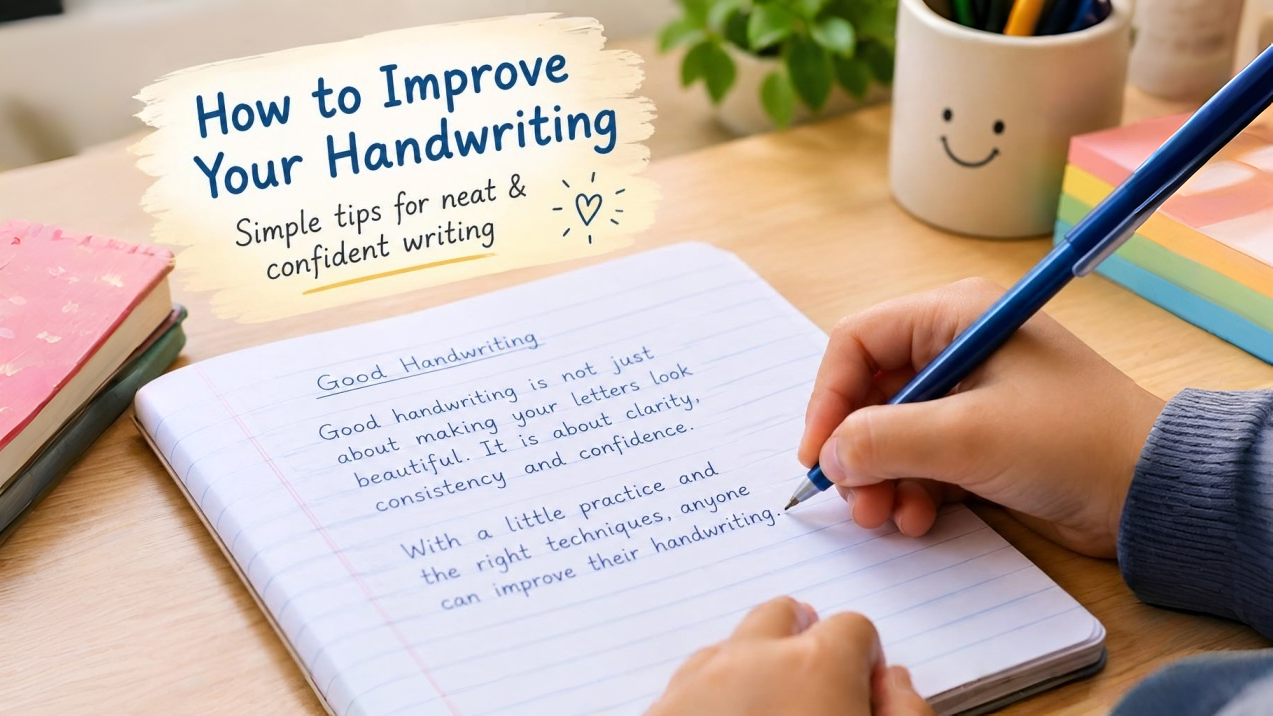
Good handwriting is not just about making your letters look beautiful. It is also about clarity, consistency, and confidence. Neat handwriting makes your schoolwork easier to read and helps you present your ideas better.
The good news is that you don’t need special talent to improve your handwriting. With a little practice and the right techniques, anyone can develop neat and readable handwriting.
The writing tool you use can make a big difference. Choose a pen or pencil that feels comfortable in your hand and allows you to write smoothly.
Avoid holding it too tightly. A relaxed grip helps your hand move naturally and prevents tiredness.
Good handwriting starts with good posture.
Sit comfortably with your back reasonably straight and keep your writing surface at a comfortable height. Place your notebook at a slight angle instead of keeping it completely straight.
A comfortable position gives your hand more freedom to move.
Don’t rush while writing.
Start by practising individual letters. Pay attention to their size, shape, height, and direction.
For example, practise:
Once individual letters become consistent, move on to words and sentences.
One common handwriting problem is uneven letter size.
Try to keep letters of the same type approximately the same height. Pay attention to the difference between small letters, tall letters, and letters that go below the line.
Consistency makes handwriting look much neater.
Spacing is just as important as the letters themselves.
Leave a small, consistent space between words and avoid letting letters inside a word become too far apart.
A simple trick is to imagine a small gap between each word.
Good spacing = Easier reading.
When writing in a ruled notebook, use the lines as a guide.
Try to keep your words sitting on the same baseline instead of allowing them to move up and down.
This one small habit can make handwriting look much more organised.
If your handwriting becomes messy when you write quickly, don’t worry.
Start slowly and focus on forming each letter correctly. Once your movements become comfortable, gradually increase your writing speed.
First aim for neatness. Then work on speed.
Some letters can be difficult to connect smoothly.
Practise combinations such as:
th, ch, sh, oo, ee, ll, mm
Then use them in simple words.
This helps improve both handwriting flow and writing speed.
One of the easiest ways to improve handwriting is regular copying practice.
Choose a short paragraph from a book or your textbook and copy it slowly for 10–15 minutes every day.
Don’t just copy the words. Observe the letter shapes, spacing, alignment, and size.
You don’t need to copy someone else’s handwriting.
Find a style that is comfortable, neat, and easy to read, and practise it consistently.
Your handwriting can have its own personality while still being clear and beautiful.
Instead of writing pages and pages without paying attention, choose one thing to improve each day.
For example:
Small improvements every day can create a big difference over time.
Handwriting doesn’t improve overnight.
Even 10 minutes of focused practice every day can help you see noticeable improvement with time.
Remember:
Take a picture of your handwriting today. After practising for a few weeks, take another picture and compare them.
You may be surprised by how much you’ve improved!
Practise. Improve. Write with confidence. ✍️📚



.jpg)